
Understanding Doña Ana County Releases
A Doña Ana County release is the end of one physical custody episode. It does not always mean the person is free of every legal restraint. Someone may leave the adult detention center on bond, after time served, following dismissal, or under another court order. A transfer to New Mexico Corrections Department custody, a federal authority, another jail, or an immigration authority is different. The person left one building, but custody continued. That distinction controls which agency has the next useful record.
Doña Ana County released inmates also come from different systems. The county detention center handles adult local custody. The juvenile center uses protected youth channels. Southern New Mexico Correctional Facility is a state prison managed by the New Mexico Corrections Department, or NMCD. A county booking number, NMCD number, court case number, or other stable identifier helps separate people with similar names. Each official source provides only part of the answer, so the record must be read in context.
- Discharge
- The completion of custody or supervision documented by the responsible agency.
- Time served
- Credit or completion of the custodial portion, although other court terms may remain.
- Detainer
- A hold or pickup request from another authority, so custody can continue elsewhere.
- Parole
- Conditional community supervision after a prison term has begun.
Doña Ana County Release Types
The release label matters. Bond allows a person to leave pretrial custody while the case continues. Personal recognizance is a judge-approved release without a commercial surety, not an acquittal. A dismissal concerns a charge, but another charge or hold may still block release. Probation can follow custody or replace more incarceration. Parole follows a prison term and keeps the person under conditions. Transfers and detainer pickups are custody moves, not community releases.
| Recorded event | Meaning | Next official source |
|---|---|---|
| Bond or recognizance | County detention ends while the case remains open | Detention release entry and court docket |
| Time served or sentence end | The custodial term was credited or completed | Release record, judgment, and any supervision record |
| Parole or probation | Community supervision continues | NMCD offender search and assigned supervision office |
| Transfer or detainer pickup | Another agency assumed custody | Receiving agency named in the movement record |
| Dismissal or court order | Legal authority may permit release after other holds clear | Court order plus the physical release entry |
A person can have more than one event on the same day. A judge may order release in one case while another warrant remains active. The detention record establishes when physical county custody ended. The court record explains the legal basis. Neither should be stretched beyond what it states.
Doña Ana Bond Release Routes
Doña Ana County documents cash, surety or professional, property, and personal-recognizance bonds. The county bonding instructions say the detention center does not process cash bonds on site. Payment goes through the court of record. The center can accept a money order or cashier’s check payable to that court, and available commissary funds may also be used. Before first appearance, cash or surety is normally the route unless a judge authorizes another form.
Bond ends the immediate detention episode once the court and facility complete processing and all other holds clear. It does not end the criminal case. The court docket may later show hearings, plea activity, dismissal, trial, or sentencing. For a same-day custody question, the detention release entry supplies the physical release time. The docket supplies the order and bond terms.
Note: A bond entry should be linked to the correct booking and case number before it is treated as proof of a specific release.
Doña Ana Release Record Fields
A useful release record identifies the custody episode, when it ended, why it ended, and where the person went. Doña Ana County’s public current profile does not display observed release fields, so the complete historical answer may require a focused county request. Ask for existing fields instead of asking the custodian to infer what happened. A booking number is especially valuable because it links the release event to one intake rather than every record under a name.
| Field | What it establishes |
|---|---|
| Booking or offender number | The exact county or state custody episode |
| Booking date | When that episode began |
| Release date and time | When physical custody at that facility ended |
| Release type or reason | Bond, court order, sentence end, parole, discharge, or another recorded basis |
| Releasing authority | The office or order that authorized the event |
| Destination or receiving agency | Whether the person entered the community or continued in other custody |
| Court and case number | The durable route to the legal disposition |
| Hold or warrant disposition | Whether another restraint affected the movement |
Not every field is public or stored in one document. Juvenile, sealed, expunged, health, victim, and security-sensitive information can be restricted. A partial record should not be filled with guesses. When the destination field names NMCD, BOP, ICE, USMS, or another jail, follow that authority and describe the event as a transfer unless a later record confirms release.
Request Doña Ana Release Records
The Doña Ana County IPRA instructions accept oral or written requests, but the statutory procedures and remedies apply to written requests. The request must include the requester’s name, address, and telephone number and describe the records with enough detail. The county’s RecordBook portal is the most direct online route. Mail or hand delivery may be addressed to the Doña Ana County IPRA Custodian, 845 N. Motel Boulevard, Box #17, Las Cruces, NM 88007.
- Identify the person with a full name and another lawful identifier. Add the booking number, booking date, and court case when known.
- Ask for the existing booking, custody-movement, and release or discharge records. Name the release date and time, type, destination, face sheet, and booking photograph if needed.
- Submit the request through RecordBook or to the county custodian. Keep the confirmation and exact wording.
- Review the response for the booking number and receiving agency. If part is withheld, read the stated legal basis and the nonexempt material supplied.
The county says records should be available at once or as practicable and no later than fifteen calendar days, subject to the Act. If they are not available within three business days, the custodian provides a written response with a production or response time. Standard single-sided copies through 11 by 17 inches are $1 per page. Special formats can have reasonable charges, and advance payment may be required. Most RecordBook responses are delivered through the portal without charge, but no booking-photo-specific price or retention period is promised.
Doña Ana Release Record Limits
New Mexico’s Inspection of Public Records Act, Sections 14-2-1 through 14-2-12 NMSA 1978, generally favors inspection while preserving statutory exceptions. The official New Mexico laws portal holds the current text. Doña Ana County’s published request procedure provides the working timeline, fees, and written-denial process. It is safer than assuming every detention item is immediately online.
No published county rule establishes that a released profile stays online for a fixed number of hours or days. The JCMS product is a current roster, not an archive. A court case can remain available longer, but public access can change through sealing, expungement, or another lawful restriction. The Criminal Record Expungement Act and current court orders control those limits.
Expunged Doña Ana Release Records
New Mexico Courts provides distinct processes for records arising from release without conviction, records tied to a conviction, and certain cannabis matters. The Judiciary’s expungement guidance links the forms and explains where a petition begins. Form 4-952 addresses qualifying release without conviction, while Form 4-953 concerns conviction records. Eligibility and waiting periods depend on current law and the individual case, so a general release search cannot decide them.
A successful expungement can remove public-facing arrest or court material. Therefore, “no case found” does not prove that a booking or release never occurred. Other explanations include a sealed case, restricted youth record, spelling difference, or an item that was never placed online. Cached images should not be used to rebuild a record that the courts have lawfully removed from public view.
Find Doña Ana Released Inmates
Begin with the custody system and a reliable identifier. The official adult county roster only shows people listed as current at its update time. Absence is a clue, not proof. A state-prison term belongs to NMCD. A federal sentence belongs to BOP, while a federal pretrial move may involve USMS. ICE uses a separate civil immigration locator. Juvenile release questions stay with authorized youth, court, facility, and family or legal channels.
- Search the official Doña Ana current roster and save its update time, booking number, and court case if the person appears.
- If the name is absent, contact the detention center or file a focused county IPRA request for the release or transfer entry.
- Search the New Mexico court case for bond, dismissal, sentence, custody-credit, release, warrant, or discharge events.
- Use VINE for an agency-fed custody event and future notice, then confirm material facts with the source agency.
- When a state transfer is plausible, search NMCD after intake processing. Use the Include Inactive filter for a past state episode.
- Use BOP, ICE, or the relevant federal court only when the facts show that federal or immigration custody applies.
The wider county fallback chain is explained for same-day use on Jail Releases: 24 Hours. For one named person, the sequence above preserves the difference between a current-roster check and actual release confirmation.
Doña Ana Current Roster Limits
The official JCMS roster is prominently labeled CURRENT. Its landing table shows booking number, last name, first name, middle name, sex, and booking date. It offers keyword search, sorting, pagination, and a last-updated timestamp. Profiles add a booking image, physical descriptors, charges, arrest details, bonds, court data, and a printable face sheet. Research did not find a released tab, release reason, release date, archive, or fixed post-release display period.
The county’s current-roster screen shows why its update stamp matters:
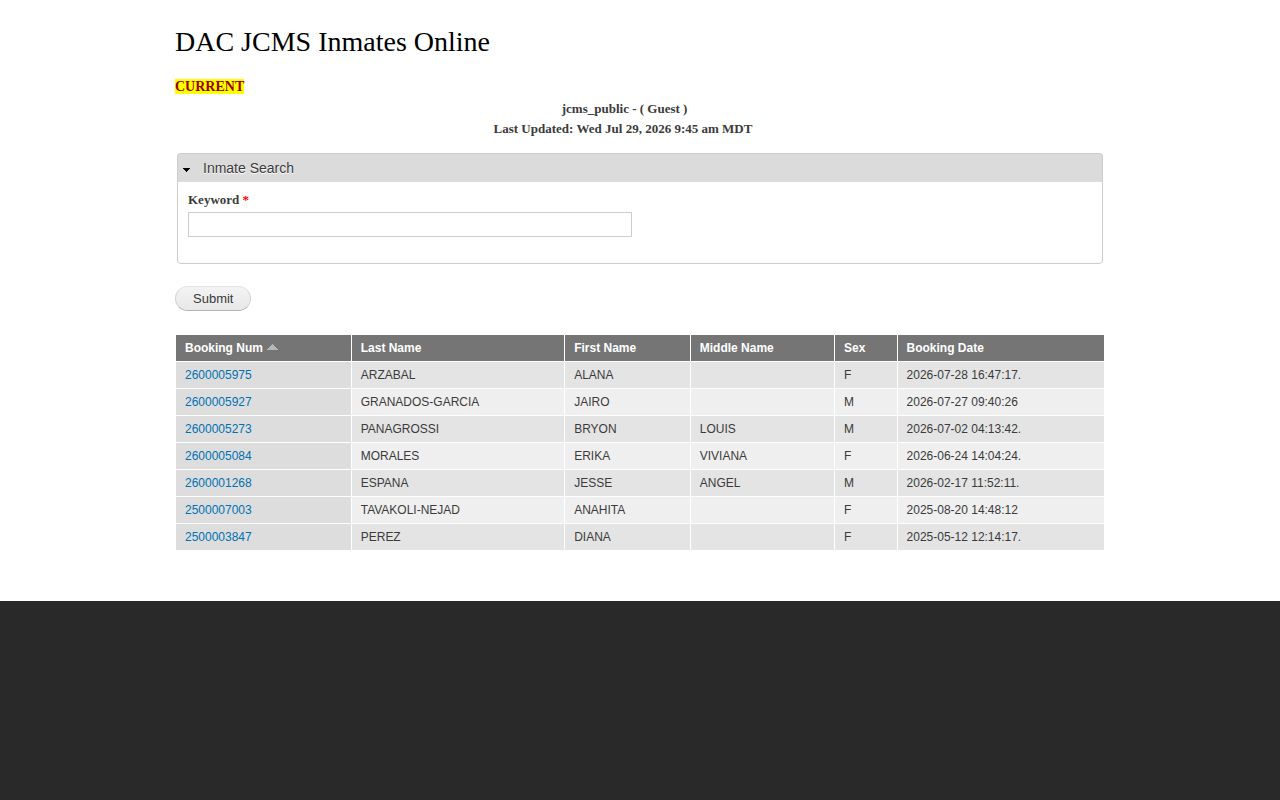
The image documents the current-custody interface, not a list of Doña Ana County released inmates. Quarter-hour timestamps were observed during research, but the county does not promise a fifteen-minute refresh. Comparing two snapshots cannot safely produce a release list because transfers, corrections, and lag look the same as release.
Note: Save the booking and court identifiers while a current profile remains visible; they make later record and court requests far more exact.
Court Fields Track Doña Ana Releases
Doña Ana’s current profile includes Court Case, Court, Judge, and Court Date for each observed charge. Those fields create a useful bridge after the person drops from the roster. Search the case number through the current New Mexico Case Lookup and review the docket for bond, conditions of release, dismissal, judgment, sentence, custody credit, probation, warrants, revocation, and discharge orders.
The court order and detention log answer different questions. A filed order explains legal authority. It may not show the moment facility staff completed identity checks, paperwork, or other hold reviews. The detention movement record supplies the physical end time and destination. Search all plausible courts if concurrent matters exist. District, magistrate, and municipal cases can create separate restraints, so release in one case does not clear another.
NMCD Doña Ana Release Search
The NMCD offender search covers people incarcerated in or supervised by the state corrections system. It is not a Doña Ana County jail archive. The live form accepts last name, first name, numeric offender number, age range, and an offender-status control. The key status choices are Active, Include Inactive, and Absconder Only. A released-first search should repeat an Active query with Include Inactive because a past NMCD episode may be hidden by the default setting.
| Search control | Use | Release caution |
|---|---|---|
| Last and first name | Find possible matches | Compare identity details before selecting a record |
| Offender number | Target one NMCD identity | Best choice when the number is known |
| Age range | Narrow common names | It does not prove identity by itself |
| Include Inactive | Find past state episodes | Necessary for a discharged-person search |
| Absconder Only | Check a supervision alert | Absconding is not proof of present incarceration |
The NMCD wrapper explains the state and county boundary and says prison information updates nightly while probation and parole information updates in real time. It may take a day for prison intake data to appear. The search was reCAPTCHA-gated during research, so no claim is made that every old discharge displays a photo, exact release date, or supervising office. Confirm uncertain movement with the institution or assigned supervision unit.
The official NMCD page shows the search entry and agency warnings:
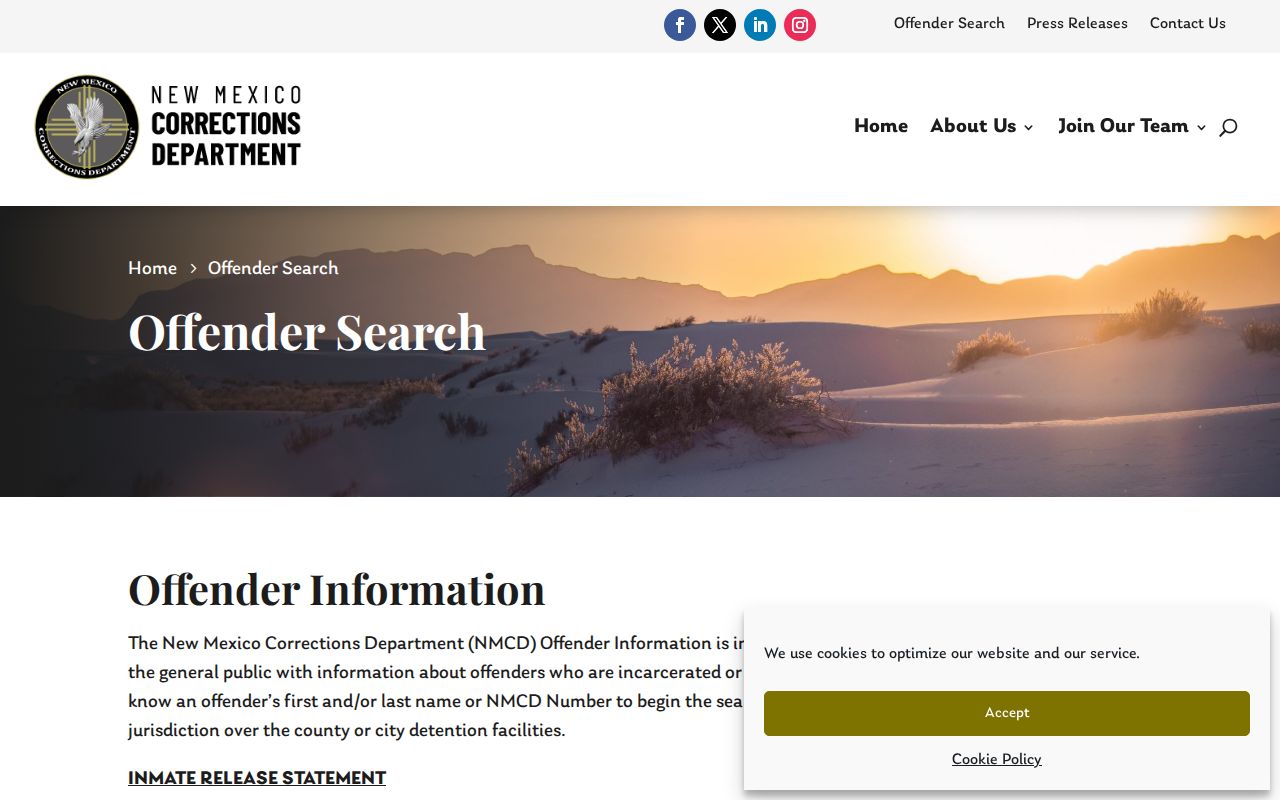
This source is correct for Southern New Mexico Correctional Facility and other NMCD episodes, not for a person whose only custody was at the county detention center.
Doña Ana Release Supervision
Parole and probation can confirm that prison or jail custody ended while legal supervision continues. NMCD places Doña Ana County in Probation and Parole Region III. The region has three district units and a hearing office in Las Cruces plus District Office 3D in Anthony. An NMCD search result should be checked with the particular listed office because assignments and personnel can change. The Region III directory remains the source of truth.
Parole follows prison and is conditional. Probation is imposed by a court and can follow custody or replace further incarceration. An absconder is a person reported as failing to remain in contact or comply with supervision. It is an alert, not a county release entry and not automatic proof of current confinement. Only the supervision office, warrant source, or court should confirm that status. Full procedures and the local office split appear on the Probation & Parole page.
Doña Ana Reentry After Release
Southern New Mexico Correctional Facility describes education and reprogramming opportunities. NMCD’s statewide Reentry Division programs also include Community Corrections residential recovery academies for some parolees and probationers. These services can help explain where an eligible person may go after state custody, but the program pages are not release records.
No program listing proves that a named person was released, accepted, or placed in Doña Ana County. Eligibility, supervision plans, and actual placement require confirmation through NMCD and the assigned officer. A favorable parole action can also be delayed until an adequate plan is arranged. The completed release audit and supervision record establish the real status.
Work Release Is Not Discharge
Doña Ana County’s inmate-program information describes a court-approved Work Release program. A participant can leave incarceration for a work shift and must return. That temporary movement is not final release from the detention center. It should never be counted as a released-inmate event.
The same care applies to medical trips, court transport, and transfers, even though the public source does not document each local process. “Left the building” is too broad. A true release record should state that the custody episode ended and identify the release basis or destination. If the movement line names a receiving authority, follow that authority instead.
Doña Ana Release Alerts
Doña Ana County links residents to VINE/VINELink for person-specific custody information and future notifications. The county describes free, confidential phone, computer, and text access in English, Spanish, and Navajo. Alerts can concern release, escape, and court appearances. VINE relays agency data, so a notice should be confirmed with the detention center or NMCD when exact timing or legal meaning matters.
Federal systems stay separate. The BOP locator covers many federal inmates released after 1982 and updates daily. A BOP RELEASED entry means BOP custody ended, not that every state, local, ICE, or supervision matter ended. USMS often manages federal pretrial transport and contract placements. ICE’s detainee locator concerns civil immigration custody. A move from Doña Ana County to either authority is not a community release unless the receiving record later says so.
Three Doña Ana Custody Systems
Doña Ana County’s local map has three distinct facilities. The adult detention center has a reported capacity of 846 and supplies the JCMS current roster. The juvenile center has a stated capacity of 50 and uses confidential youth channels. Southern New Mexico Correctional Facility houses NMCD prisoners at levels 2, 3, and 4 and in restrictive housing. Their release records cannot be exchanged merely because all three facilities are in the county.
| Facility | Custody and release route |
|---|---|
| Doña Ana County Detention Center | Adult county roster, county release record, court, and VINE |
| Doña Ana County Juvenile Detention Center | Authorized juvenile court, CYFD, facility, and family or legal channels |
| Southern New Mexico Correctional Facility | NMCD offender search, institution record, parole, probation, or discharge |
The City of Las Cruces does not present a separate public jail-release search. City police announcements describe arrestees as booked at the county detention center. Nearby Otero facilities are outside Doña Ana County and must not be assumed as a destination. A county movement record should name the actual receiving agency.