
Juvenile Release Authorization
Release information for the Doña Ana County Juvenile Detention Center follows confidentiality rules that do not apply to the adult jail roster. The right starting point depends on the person's legal connection to the youth and the case. An authorized parent or guardian may receive instructions through the facility or assigned case professional. Counsel should use the court and case channels available to the lawyer. Other parties should not attempt to obtain or circulate a youth's custody details.
A release can involve a juvenile court order, a placement decision, a return to an authorized caregiver, or movement within the youth justice system. Physical departure from the juvenile center does not, by itself, describe the legal outcome or destination. The authorized case record and responsible agency supply that context. Public silence is not evidence of custody, release, or any particular case result.
CYFD Juvenile Release Oversight
The New Mexico Children, Youth and Families Department provides statewide certification and compliance context for juvenile facilities. Its role is distinct from an adult inmate search. The CYFD certification and compliance page lists the Doña Ana County Juvenile Detention Center within that oversight framework. The page helps confirm the facility's juvenile status and the state program involved. It does not create an open directory of detained or released youths.
The successful manifest image is a neutral capture of that official CYFD source.
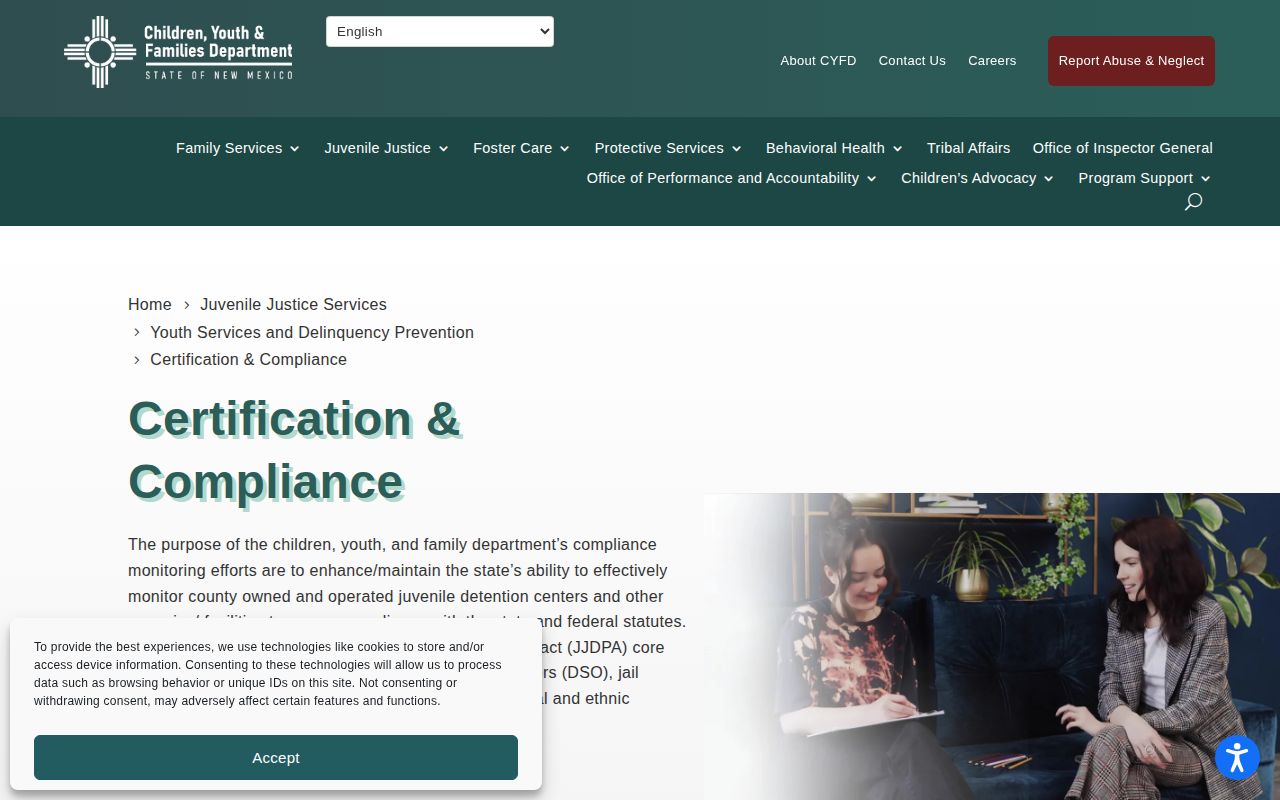
The agency context supports the correct route: facility certification can be public while an individual youth's custody and release information remains protected.
Note: A public facility listing confirms oversight status, not the identity, location, release date, or case status of any youth.
Juvenile Release Court Route
The court order is the legal source for a youth's detention or release terms. An authorized person should use the court named on case paperwork and the contact method supplied for that proceeding. The Third Judicial District Court is the official district-court source for Doña Ana County, but public web access should not be assumed to expose a juvenile case. General case-search availability does not cancel the separate rules that protect youth proceedings and records.
Ask for process, not public disclosure. A parent, guardian, lawyer, or case party may need to confirm the next hearing, the effect of an order, who may receive the youth, or which agency controls placement. Court staff can provide permitted procedural information but do not replace legal advice. Counsel is the right source for interpreting the order and resolving a disagreement about access.
| Question | Authorized route |
|---|---|
| What does the order require? | Assigned lawyer or juvenile court |
| Who may receive the youth? | Facility and assigned case professional |
| Did placement change? | Assigned CYFD or juvenile-justice contact |
| What may be disclosed? | Court, counsel, or lawful record custodian |
Juvenile Release Record Limits
New Mexico's public-record framework favors access to many government records, but other law can protect juvenile material. The official New Mexico statutory portal is the source for current law. A youth record may also contain protected health, victim, safety, placement, or court information. The lawful custodian determines what an authorized requester may receive and what must be withheld, redacted, or handled through the court.
A narrowly framed request is still better than a broad demand. An authorized requester can identify the youth and case through a secure channel, state the legal relationship, and ask which existing release or placement document is available to that person. Do not post names, birth dates, case numbers, addresses, or release plans in a public message. The privacy boundary applies even when someone believes a release has already occurred.
- Authorized party
- A person whose legal role permits access under the rules governing the case.
- Placement
- The approved setting or custodian responsible for the youth after a court or agency decision.
- Release order
- A court direction governing the youth's departure and any related conditions.
- Confidential record
- Information whose access is restricted by law or court rule.
Nothing about a public search result should be used to fill gaps in a protected record. Similar names, sealed matters, and restricted access can all produce an empty public response. The safe conclusion is only that the public tool did not supply information.
Juvenile Release Contact Route
The county describes the youth center as part of the detention operation on the Copper Loop campus. The Doña Ana County detention overview provides the official facility context and the county detention center's main information number. No separate public youth-release line, routine release schedule, waiting location, or public lookup is documented in the research. An authorized caller should use the case-specific contact when available and ask the county line for the proper confidential channel when it is not.
Doña Ana County Detention OperationCopper Loop campus
Las Cruces, NM 88005
575-647-7600
Ask for the authorized juvenile contact route
Calling does not guarantee disclosure. Facility staff must first protect the youth's identity, location, and release plan. Be prepared to provide contact information and proof of relationship through the method staff direct. Do not leave sensitive details in an unsecured voicemail unless the facility specifically requests them.
Three Doña Ana Release Systems
Doña Ana County has a distinctive three-part custody structure. The county detention department operates the 846-capacity adult center and the separate 50-bed juvenile center. The youth facility was built in 2000, opened in 2001, and contains five ten-youth units. Southern New Mexico Correctional Facility, though also in the county, is an NMCD state prison. These facts come from the county and state facility sources, not from a shared roster.
That local structure makes classification essential. Adult JCMS applies to current adult county detention. Confidential juvenile channels apply to youths. The statewide NMCD search applies to adults in state corrections custody or supervision. Moving a name from one tool to another without first identifying the legal system can produce a false conclusion and expose information that should stay protected.
Youth Releases Exclude Adult Rosters
The adult current roster is not a fallback for a juvenile inquiry. It covers the adult detention center and presents adult booking fields. Likewise, NMCD's offender search covers adult prison and probation or parole information. Neither tool should be used to infer that a youth was released, transferred, or never detained. VINE participation for the adult center also does not prove that a particular youth event is available through the same public interface.
The absence of a public juvenile list is a privacy control, not a data failure. Authorized people still have routes through the facility, CYFD, counsel, and the juvenile court. Those routes may require identity checks and may provide information only to the extent allowed. Everyone else should respect the boundary and avoid seeking private youth information through unrelated adult databases.